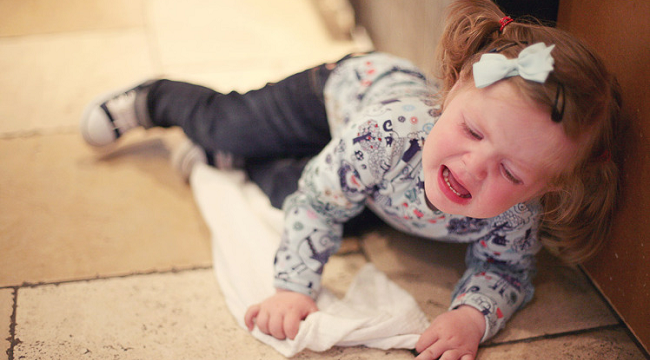
Every parent swears their child is the most adorable of all. Until that child is in the middle of the supermarket, shrieking at the top of her lungs as spittle foams around the side of her mouth, pounding the floors with her fists in an utter outrage because Mommy won’t buy her candy. And then Mommy checks her smartphone to see which other supermarkets are nearby so she never again has to show her face in the one her daughter just embarrassed her in.
What Mommy doesn’t realize is that this happens to every parent sooner or later.
Throwing tantrums is fairly normal for children starting aged 2 to 5. Their brains aren’t fully developed at this stage and thus, they cannot rationalize the way adults can. This is why attempting to reason with a toddler goes over as well as a lead balloon.

Tantrums are going to happen during this developmental stage, but you can do your part to minimize their frequency and diffuse them before they become epic.
Ideally, you’ll be at home when your child has a major meltdown. But even if you’re not, the most important thing you can do is to stay calm. Tempting as it may be to scream right back at your child, don’t do it. If you’re at home, resist the urge to duck into another room. Your child just needs to work through her feelings and knowing you’re right there (even if she’s shouting and off the rails) will help her settle down.
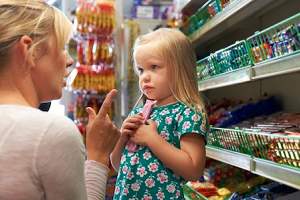 Should you find yourself at the supermarket, or any other public venue, when your child goes into full-blown tantrum mode, the best thing you can do is take your child and leave. Tell her calmly that this is not the way we behave in public and that you’re going home. Whatever you do, don’t give into her unreasonable demands because when you do, you’re just reinforcing bad behavior. (If you give in, she’ll essentially learn that screaming, flailing and acting like a monster will get her the things she wants, and that’s not the lesson you want her to learn, is it?)
Attempting to reason with a child mid-tantrum is also a bad idea. It will only add fuel to the fire. You’ll definitely want to talk to your child about her behavior, but not until she calms down first. Then you can figure out why the tantrum occurred.
Sometimes, children throw tantrums because they are hungry or overtired. If you can determine that one of those factors contributed to the tantrum, then you can plan ahead in the future. For example, if your child gets cranky when she’s hungry, head her off at the pass by making sure you’ve got plenty of nutritious snacks that she likes with you. If you know she tends to get sleepy around a certain time, try to avoid going anywhere during that time frame. She might just need a nap.
Indeed, tantrums are embarrassing, but another undesirable behavior small children might exhibit is aggression, such as hitting or biting.
Most children have dabbled in these behaviors from one time or another and eventually learn that this isn’t the way they’re supposed to act with others. Ideally, they learn this because they are given a consequence for their bad behavior.
Again, reasoning is not going to work with a small child. So if your son starts hitting the other children in the play group, you’ll want to have him sit out for a bit and watch the others having fun. It may take a few tries but he will make the connection and learn that being mean keeps him from playing with his friends.
 Aggressive behavior often occurs between siblings too. If you have more than one child, no doubt you’ve interceded on one’s behalf while the other one bawled away. It’s going to happen as they go through this growth period but by providing consistent discipline, it’s going to start happening a lot less. If your elder child hits his little sister and you give him a time out each time it happens, he’s going to learn that hitting leads to time outs, which are not fun.
It’s not enough to just give a time out though. Once the dust has settled, you’ll need to talk to him about this. Let him know that it’s okay to have the feelings he has. If he’s angry with his brother, let him know he’s allowed to feel that way and he’s allowed to say that he’s angry, but he is not allowed to hit, kick, bite or inflict any other physical harm on his brother, or anyone else for that matter. Teach him how to verbalize it so that when his brother does something that makes him angry again (because you know it will totally happen again), he can say it instead. And be sure to teach your child that when they’ve done something wrong like hit their sibling, it’s important to apologize and say sorry.
When you see that your child voices his unhappiness instead of hitting his brother, praise the good behavior and make a big deal about how proud you are. This helps reinforce the positive behavior. With this kind of encouragement, you’ll soon start seeing less of those unpleasant negative behaviors.
Sometimes, children misbehave because they have too much energy and just need to burn it off. All children need an outlet for their never-ending supply of energy. Exercise is a great way to let it out. Have them play in the yard, or take them to the park. And be sure to play with them too, because spending time with you will make them feel happy and loved, and no matter how horribly our children ever act, it’s so important to make sure that they always feel the warmth of your love.
For a more concrete approach to handling toddler behavior issues, check out Chris Thompson’s “Talking To Toddlers” FREE presentation with more specific examples to aid you in effectively dealing with small children behavior problems.


 207
207 83
83 0
0 16.4k
16.4k 50
50
This is an article that a lot of parents need to read. I’ve seen my brother try to “deal” with my nephew having tantrums while in the store or just at home, and it’s usually give in or let him cry it out. Either way it’s not really handling it. For a little while I was staying with my brother and when he was at work my nephew had a tantrum, and instead of just letting him get what he wanted I sat down with him and let him cry for little bit until he started to calm down. Once he got to where he was just sniffling I asked him to tell me what he was feeling and why he started crying. In the end he agreed to do what I asked so he could do what he wanted, and since then he has started to verbalize that he is upset rather than cry and scream. With little ones it’s a process, and this article is definitely a great starting point.